
Leave Your Message
The Wooden Spoons remain practical, renewable, and surprisingly diverse. Global buyers now compare wood species, grain direction, finish, durability, and sourcing records before placing orders. This guide, “Top 10 Types of Wooden Spoons for Global Buyers,” examines those details through a purchasing lens.
Grand View Research’s kitchen utensils market analysis identifies durability, natural materials, and household cooking demand as important market influences. The report does not isolate wooden spoons, so its findings require careful interpretation. The FAO Global Forest Resources Assessment 2020 recorded approximately 4.06 billion hectares of forest worldwide. That figure does not make every wooden product sustainable. Species selection and traceable harvesting still matter. FSC’s certification data also shows the scale of responsible forest management, with hundreds of millions of hectares connected to certified supply chains.
Robin Wood, a respected spoon carver and woodworking educator, has said, “Spoons are the perfect place to start carving.” His point is simple. Spoon design reveals wood behavior clearly. Beech offers dependable hardness. Olive wood brings strong grain and visual warmth. Maple suits smooth, frequent stirring. Teak resists moisture, but sourcing deserves closer scrutiny. Bamboo is often marketed as wood, although botanically it is grass.
Small differences matter. A thin edge can scrape a pan neatly. A deep bowl can hold thicker sauces. However, no single spoon fits every kitchen, climate, or buyer requirement. That remains an inconvenient truth. Some product comparisons also overlook handle comfort and finishing quality. This outline addresses those gaps, while encouraging buyers to verify species, coating safety, factory practices, and supplier documentation before purchase.
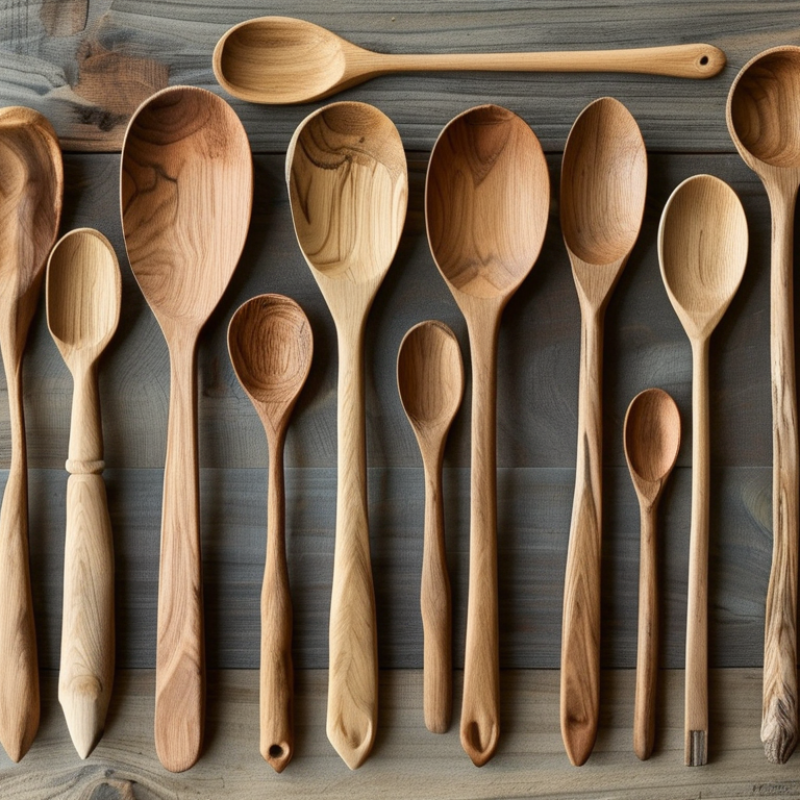
A wooden spoon type is defined by more than its appearance. Global buyers should examine its purpose, wood species, bowl shape, handle length, and surface treatment. A deep bowl suits soups and stews. A shallow bowl gives better control when tasting or stirring sauces. Slotted designs release liquid, while solid serving spoons retain it.
In practical sourcing work, I classify ten common types: cooking, tasting, serving, slotted, rice, soup, salad, baking, measuring, and stirring spoons. Each type reflects a different kitchen task. Material also matters. Beech offers a fine, even grain. Maple feels dense and smooth. Olive wood has visible grain variation and a more decorative character. Buyers should check moisture content, food-contact finishing, edge smoothness, and handle balance. These details affect durability and user comfort.
The category lines are not always clean. A long stirring spoon may also serve baking needs. A rice spoon can work well for vegetables. I once judged a spoon by its polished surface alone, which was a mistake. A glossy finish did not guarantee balanced weight or a durable bowl. Manufacturing tolerances can vary between production batches. Buyers should request samples, inspect grain direction, test the spoon in hot and cold foods, and confirm packaging requirements before placing larger orders. Small differences matter.
| No. | Wooden Spoon Type | Common Wood or Material | Defining Design Feature | Typical Length | Primary Kitchen Use | Important Buying Considerations |
|---|---|---|---|---|---|---|
| 1 | Classic Stirring Spoon | Beech, maple, birch, or bamboo | A medium-depth oval bowl with a solid, slightly curved handle | 25–35 cm | Stirring soups, sauces, stews, grains, and general cooking | Choose a smooth, rounded handle and a bowl with no sharp interior edges. A versatile profile is suitable for most household and food-service applications. |
| 2 | Slotted Wooden Spoon | Beech, maple, olive wood, or bamboo | A solid bowl containing narrow slots or elongated drainage openings | 28–35 cm | Lifting vegetables, pasta, dumplings, and other foods while draining liquid | Slots should be cleanly cut and easy to rinse. The opening size affects drainage, so buyers should match it to the food being handled. |
| 3 | Perforated Mixing Spoon | Beech, birch, maple, or bamboo | A broad, shallow bowl with several round or small punched holes | 25–33 cm | Mixing and folding ingredients while allowing some liquid or oil to pass through | Uniform holes and a thick surrounding bowl improve strength. The design is useful for mixing but is less suitable for very liquid sauces. |
| 4 | Corner Spoon | Beech, maple, walnut, or bamboo | A squared or angled bowl designed to reach into the corners of cookware | 28–35 cm | Scraping and stirring food in square baking dishes, sauté pans, and flat-bottomed pots | The corners should be rounded enough to avoid damaging cookware while remaining defined enough to collect food from pan edges. |
| 5 | Risotto Spoon | Olive wood, beech, maple, or bamboo | A wide, shallow, oval bowl with a gently tapered front edge | 28–33 cm | Continuously stirring risotto, rice dishes, creamy grains, and thick sauces | A broad bowl distributes pressure across the pan and helps fold ingredients. A polished, rounded edge is preferable for coated cookware. |
| 6 | Sauce Spoon | Maple, beech, olive wood, or bamboo | A deeper, narrow bowl that can hold and pour small amounts of liquid | 24–32 cm | Stirring, tasting, and serving gravies, reductions, custards, and other sauces | Look for a deep bowl with a comfortable pouring angle. A relatively thin but strong edge helps scrape the bottom of a saucepan. |
| 7 | Tasting Spoon | Beech, maple, birch, or bamboo | A small, shallow bowl attached to a compact handle | 15–25 cm | Sampling seasonings, sauces, soups, beverages, and small portions during preparation | A smooth finish and compact profile are essential. For professional use, buyers should consider purchasing multiple spoons to prevent cross-contact between tastings. |
| 8 | Rice Paddle | Bamboo, beech, or birch | A broad, flat, rounded blade, sometimes with shallow texture lines | 18–23 cm | Serving and fluffing cooked rice, grains, and sticky foods | The wide blade should be strong but not excessively sharp. Bamboo is commonly selected because it is lightweight and naturally suited to a flat paddle form. |
| 9 | Salad Serving Spoon | Olive wood, acacia, beech, or bamboo | A large oval bowl designed for scooping and lifting leafy ingredients | 25–32 cm | Serving salads, pasta salads, fruit, vegetables, and side dishes | A broad bowl improves portion control. Buyers should check that the handle-to-bowl joint is securely constructed for repeated serving use. |
| 10 | Honey Dipper Spoon | Beech, maple, bamboo, or olive wood | A grooved, rounded head rather than a conventional open spoon bowl | 12–18 cm | Collecting and drizzling honey, syrups, and other viscous liquids | Deep, evenly spaced grooves improve retention and release. The surface should be free from cracks because sticky foods can remain in damaged areas. |