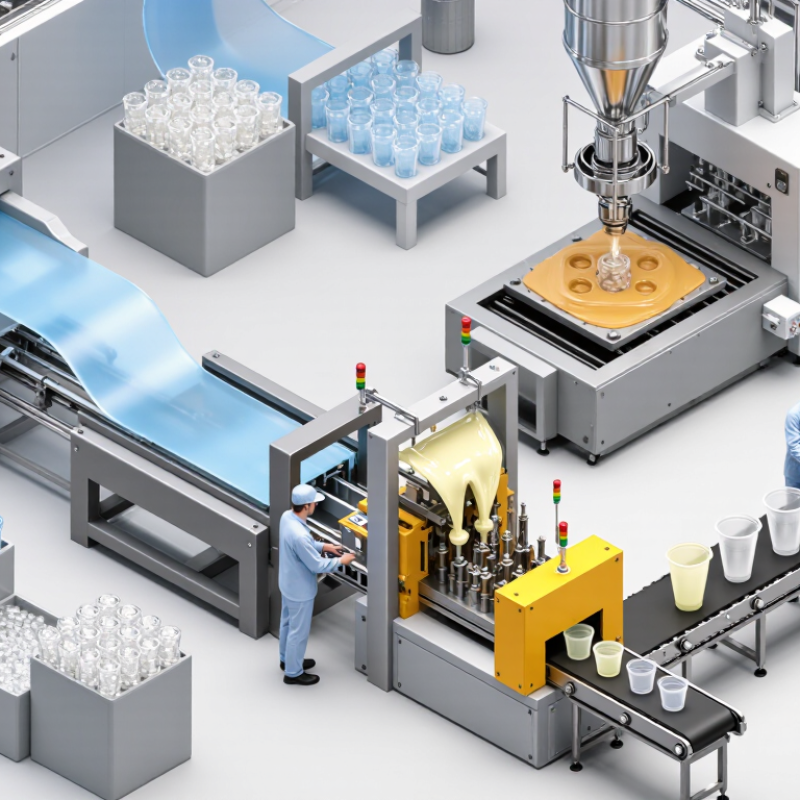
A Plastic Cup looks simple, but its production combines material science, heat control, design, and strict quality checks. From a factory floor, the process feels surprisingly precise. Small resin pellets enter a heated machine, soften, and become a clear or colored sheet. Some cups are formed from that sheet through thermoforming. Others are created by injection molding, where melted plastic fills a shaped mold under pressure.
Packaging expert Dr. Susan Selke has observed, “Packaging is an integral part of the product.” This idea matters when examining a Plastic Cup. The cup must hold liquid safely, resist cracking, remain stable during transport, and feel comfortable in the hand. Manufacturers may use polypropylene, PET, or polystyrene, depending on the required strength, clarity, temperature resistance, and cost. Each material behaves differently.
The details are visible. A warm plastic sheet presses against a mold. Air removes gaps. Cooling fixes the final shape. Trimmed edges become smooth and uniform. Quality teams inspect thickness, weight, appearance, and seal performance. Food-contact requirements also influence inks, additives, and production cleanliness.
It is not perfectly simple.
Many people assume every plastic cup has the same environmental impact. That assumption needs correction. A cup’s footprint depends on its resin, production energy, transport distance, use pattern, and available recycling systems. Lightweight design can reduce material use, but recycling remains inconsistent in many regions. Understanding how a Plastic Cup is made helps buyers, manufacturers, and users judge its practical benefits and limitations more honestly.
A plastic cup is a lightweight container made from synthetic polymers. It holds cold drinks, hot beverages, desserts, and small food portions. Manufacturers usually begin with plastic pellets, which are melted and shaped under controlled heat. Some cups are injection molded, while others are formed from thin plastic sheets. The method affects thickness, clarity, strength, and cost.
Several plastic types appear in everyday cups. PET cups are clear, smooth, and commonly used for chilled drinks. They show the drink’s color well.
PP cups resist heat better and bend without breaking easily. They suit warm beverages and reusable designs.
PS cups are stiff and inexpensive, but they can crack under pressure.
PLA cups come from plant-based materials and are often used for cold drinks. They may require industrial composting facilities, not ordinary home compost bins.
The material code does not tell the whole story. A cup marked recyclable may still lack collection facilities in a particular area. That detail is easy to overlook. Cup lids, coatings, dyes, and mixed materials can also complicate processing.
From practical handling, a thicker rim usually feels safer and prevents spills, but it uses more material. Thin cups save resources, yet they may collapse when filled. The best choice depends on temperature, drink weight, use time, and local waste systems. Plastic cups are simple products, but their design involves more trade-offs than they first suggest.
What Is a Plastic Cup and How Is It Made?
Raw Materials Used to Make Plastic Cups
Plastic cups usually begin with polymer pellets, small solid grains supplied to a manufacturer. Polypropylene, polyethylene terephthalate, and polystyrene are common choices. Each material gives the cup different qualities.
Polypropylene is lightweight, flexible, and suitable for many hot or cold drinks. Polyethylene terephthalate is clearer and feels more rigid. Polystyrene can create a smooth, lightweight cup, but it may crack more easily under pressure. The selected polymer affects temperature resistance, transparency, strength, and recycling options.
Small quantities of additives may also enter the mixture. Colorants provide a consistent appearance. Stabilizers help the plastic tolerate heat during processing. Processing aids can improve flow through molding equipment. These ingredients must be carefully controlled, especially when cups contact beverages or food. Supplier documents and laboratory testing help confirm the material’s intended use.
Some manufacturers include recycled plastic, depending on the product design and local requirements. Recycled content can reduce demand for new raw materials, but it may affect clarity, color, or consistency. Clean collection systems matter greatly. Otherwise, contamination can lower quality.
The pellets are heated until they soften. The material then enters a mold, where pressure forms the cup’s shape. It cools, hardens, and receives inspection. Simple process, complicated choices. A clear cup may look harmless, yet its material history deserves closer attention. No option is perfect.
A plastic cup is a lightweight container made from polymers such as polypropylene or PET. Its production begins with small plastic pellets. Workers check the material for moisture, color consistency, and contamination. Even a small impurity can weaken the finished cup.
The pellets enter a heated machine and soften into a thick, flowing material. In injection molding, the machine presses this material into a metal cup mold. Thermoforming uses heated plastic sheets instead. The sheet bends over a mold and takes its shape. Cooling follows quickly. This locks in the cup’s thickness and structure.
The formed cups then pass through trimming equipment. Sharp edges are removed carefully. Sensors inspect the rim, wall thickness, shape, and surface. Quality teams also perform practical checks, including stacking tests and leak inspections. Some cups receive printed designs, while others remain clear or plain. Packaging keeps dust away during storage and transport.
No manufacturing line is flawless. Heat can vary across a mold, creating thin spots or slight warping. Experienced technicians adjust temperature, pressure, and cooling time to reduce these problems. They also record production data for traceability and safety reviews. A cup may look simple, but its reliability depends on controlled materials, accurate equipment, and repeated inspection.
What Is a Plastic Cup and How Is It Made?
A plastic cup is a lightweight container formed from polymer resin. Common materials include polypropylene, polystyrene, and polyethylene terephthalate. Manufacturers melt plastic pellets, shape them by injection molding or thermoforming, then cool and trim each cup. Clear cups offer visibility, while opaque cups often provide better light protection. PlasticsEurope reported global plastic production of 400.3 million tonnes in 2022. Packaging remains a major application, although production volume does not equal responsible use.
Properties, Uses, and Safety Considerations
Plastic cups resist breaking, moisture, and many mild chemicals. They suit water, cold drinks, takeaway service, laboratories, and events. However, heat resistance varies sharply by polymer and cup design. A thin cold-drink cup may deform around hot coffee. Food-contact safety depends on approved materials, manufacturing controls, and migration testing. The United Nations Environment Programme reports that over 430 million tonnes of plastic are produced yearly, with about two-thirds becoming short-lived products. This figure makes disposable use harder to defend, even when recycling symbols appear. Recycling access differs widely, and a code does not guarantee local processing. No material choice is flawless.
Tips: Check the cup’s intended temperature range. Avoid using damaged or cloudy cups repeatedly. Do not microwave a cup unless its instructions permit it. For reusable designs, wash with mild detergent and inspect the rim, base, and inner surface. Local recycling guidance matters more than assumptions. Small habits help, but the system still needs improvement.
| Data Dimension | Key Information | Typical Examples or Values | Practical Significance |
|---|---|---|---|
| Definition | A plastic cup is a rigid or semi-rigid drinking container made from a synthetic polymer. | Common forms include disposable cold-drink cups, reusable tumblers, and laboratory or food-service cups. | Its properties depend mainly on the polymer type, wall thickness, additives, and manufacturing process. |
| Common Materials | Food-contact cups are commonly manufactured from polymers selected for clarity, toughness, heat resistance, or low cost. | Polypropylene (PP), polyethylene terephthalate (PET), polystyrene (PS), high-density polyethylene (HDPE), and polycarbonate (PC). | Different materials provide different combinations of transparency, flexibility, temperature resistance, and impact strength. |
| Polypropylene (PP) | A lightweight polymer with good chemical resistance and relatively high heat resistance among common disposable-cup plastics. | Density is approximately 0.90 g/cm³; melting range is commonly about 160–170°C. | Often used for reusable cups, hot-food containers, and cups that may be exposed to moderate heat. |
| Polyethylene Terephthalate (PET) | A clear, strong polymer with good barrier properties and high recyclability where collection systems accept it. | Density is approximately 1.35–1.40 g/cm³; commonly used for clear cold-drink cups and containers. | Provides good clarity and rigidity, but ordinary PET cups are generally not intended for very hot liquids. |
| Polystyrene (PS) | A rigid, lightweight polymer that can be produced as either clear plastic or expanded foam. | Density of solid PS is approximately 1.04–1.06 g/cm³; softening behavior depends on grade and formulation. | Offers low cost and rigidity, but it can be brittle and has limited resistance to high temperatures. |
| Manufacturing Method | Most disposable plastic cups are formed by heating plastic sheet or pellets and shaping the softened material. | Thermoforming is widely used for thin-wall cups; injection molding is common for thicker or reusable cups. | The selected process affects production speed, wall thickness, dimensional accuracy, and material waste. |
| Thermoforming Steps | Plastic pellets are melted into sheet or preformed sheet is heated, shaped over a mold, cooled, and trimmed. | Typical steps: sheet preparation, heating, forming, cooling, edge trimming, inspection, and packaging. | Thermoforming is efficient for high-volume production of lightweight cups with consistent shapes. |
| Injection Molding Steps | Plastic pellets are melted and injected under pressure into a mold, then cooled and ejected. | Typical steps: pellet drying when required, melting, injection, cooling, ejection, and quality inspection. | This method supports detailed designs, thicker walls, integrated features, and reusable cup construction. |
| Physical Properties | Plastic cups are generally lightweight, moisture-resistant, electrically insulating, and resistant to many dilute chemicals. | Low mass, smooth nonporous surfaces, and adjustable rigidity or flexibility. | These properties make plastic cups convenient for transport, storage, outdoor use, and high-volume food service. |
| Thermal Limitations | Temperature performance varies substantially by polymer, cup design, and intended-use labeling. | Some cups are designed for cold beverages only; heat-resistant grades may tolerate hot liquids but can still deform under excessive heat. | Users should follow the cup’s temperature instructions and avoid using cold-drink cups for boiling liquids. |
| Typical Uses | Plastic cups are used wherever lightweight, low-cost, shatter-resistant containers are useful. | Cold beverages, water service, events, take-away drinks, food sampling, travel, household use, and laboratory applications. | The application should match the cup’s material, strength, temperature rating, and food-contact suitability. |
| Food-Contact Safety | Materials intended for food contact must comply with applicable regulations and manufacturing controls in the market where they are sold. | Relevant factors include polymer identity, additives, colorants, processing aids, and migration testing. | Food-contact suitability cannot be determined from appearance alone; use products labeled or certified for the intended application. |
| Chemical Migration | Small quantities of substances can potentially migrate from plastic into food or beverages, especially under unsuitable conditions. | Migration risk may increase with high temperatures, long contact times, fatty foods, acidic contents, or repeated use of products not designed for reuse. | Use the cup according to its instructions and avoid heating or storing contents in it unless the product is specifically designed for that purpose. |
| Microwave Use | Microwave suitability depends on the specific plastic formulation and product design. | Only cups explicitly labeled as microwave-safe should be used in a microwave oven. | Unmarked or disposable cups may deform or allow greater migration when heated; transfer contents to a microwave-safe container when uncertain. |
| Reuse Considerations | Not every disposable cup is designed for repeated washing, heating, or mechanical stress. | Reusable cups should have durable walls and clear care instructions; disposable cups should generally be used for their intended service period. | Discard cups that become cracked, cloudy, heavily scratched, or permanently deformed. |
| Recycling Identification | Resin identification codes indicate the primary plastic type, but they do not guarantee that local recycling facilities accept the item. | Common codes include 1 for PET, 2 for HDPE, 5 for PP, and 6 for PS. | Check local collection rules, empty and rinse containers when required, and keep nonaccepted materials out of recycling streams. |
| Environmental Factors | Environmental impact depends on material production, cup weight, transportation, reuse frequency, collection, and end-of-life treatment. | Lightweight cups use less material per unit, while durable reusable cups can reduce single-use consumption when used many times. | Choosing the correct product, avoiding unnecessary use, and following local recycling or waste guidance can reduce environmental burdens. |
| Quality-Control Checks | Manufacturers commonly inspect dimensions, wall thickness, appearance, sealing performance, strength, and contamination control. | Checks may include leak testing, rim inspection, drop or compression testing, and food-contact compliance verification. | Consistent quality helps prevent leaks, sharp edges, cracking, deformation, and unsafe use during storage or serving. |
| Safe-Use Checklist | Use the cup only for its labeled purpose and observe temperature, cleaning, storage, and disposal instructions. | Avoid boiling liquids in cold-drink cups, do not use damaged cups, and keep cups away from open flames or direct high heat. | Correct use reduces the likelihood of burns, spills, deformation, contamination, and premature product failure. |

A plastic cup is a lightweight container made from polymer resin. Common materials include polypropylene, PET, and polystyrene. Manufacturers melt small resin pellets and shape them through injection molding or thermoforming. Injection molding creates rigid cups, while thermoforming presses heated sheets into molds. This process is fast and economical. However, thin walls can make cups harder to sort and recycle profitably.
According to the OECD’s Global Plastics Outlook, the world generated 353 million tonnes of plastic waste in 2019. Only 9% was recycled, while about 22% was mismanaged. Those figures expose the gap between recyclable design and actual recovery. A used cup may contain liquid, food residue, or a paper sleeve. Sorting facilities must remove these materials before processing. Mixed polymers also reduce recycling efficiency. Recycling is not automatic. Local collection rules vary widely, so a recycling symbol alone proves little.
The 2023 UNEP report, Turning off the Tap, estimates that reuse systems could reduce plastic pollution by 30% by 2040. Reusable cups still require washing, transport, and energy. That is not a free solution. Their benefits depend on frequent use and efficient cleaning systems. A disposable cup may use little material, yet it often has a short life of minutes. A reusable cup needs repeated use to offset its production impact. The uncomfortable truth is that better recycling helps, but it cannot repair unlimited consumption. Design matters.
Plastic cups are commonly made from polymers such as polypropylene (PP), polystyrene (PS), or polyethylene terephthalate (PET). Their environmental impact depends largely on production, use, collection, and end-of-life treatment. The chart shows the global end-of-life distribution of all plastic waste in 2019, which provides context for the recycling challenges faced by plastic cups. Only 9% of plastic waste was recycled, while 50% was sent to landfill and 22% was mismanaged.
Source: OECD, Global Plastics Outlook, data for 2019.